
Back in July 1994, when Roger DeCoster was in charge of Dirt Bike Magazine’s testing department, he got a rare opportunity. He got to test the very bike that Bob Hannah raced in 1979. It was the OW40, which was reputed to be one of the greatest works Yamahas of its era. This particular bike was—and still is—owned by Terry Good of the International MX Museum, who graciously tossed Roger the keys for a feature in the July 1994 issue of Dirt Bike.
“I would have loved to have ridden this bike back in the late ‘70s,” said Roger. “Back then I would have been interested in knowing all about the competition—about where they were ahead of us or behind us.
“At that time, Yamaha’s works rear suspension was working well. It was better than that of the Suzukis I rode in ‘78 and ‘79, and much better than that of the Honda when I started there. I had believed my 250 Suzuki turned a little better, but in ‘79 I wasn’t very happy with our works Suzukis. They were very tall and awkward, so I thought that the Yamahas had an overall advantage, especially in the 500 class.”
Roger was finally able to spin a few laps on the OW40 15 years later. It was a muddy day at RedBud in Michigan, and Terry brushed the cobwebs off the OW. Who cares if it gets a little dirty? Thirty minutes and a few laps around a make-shift grass track later, Roger got off the bike with some of his preconceptions ratified and some dispelled: “The rear suspension is good, even better than some modern bikes. It’s surprisingly forgiving. If it swaps sideways, it steps back in Iine quickly. Back in ‘79, the Suzuki would keep on swapping until you hit something to stop it.
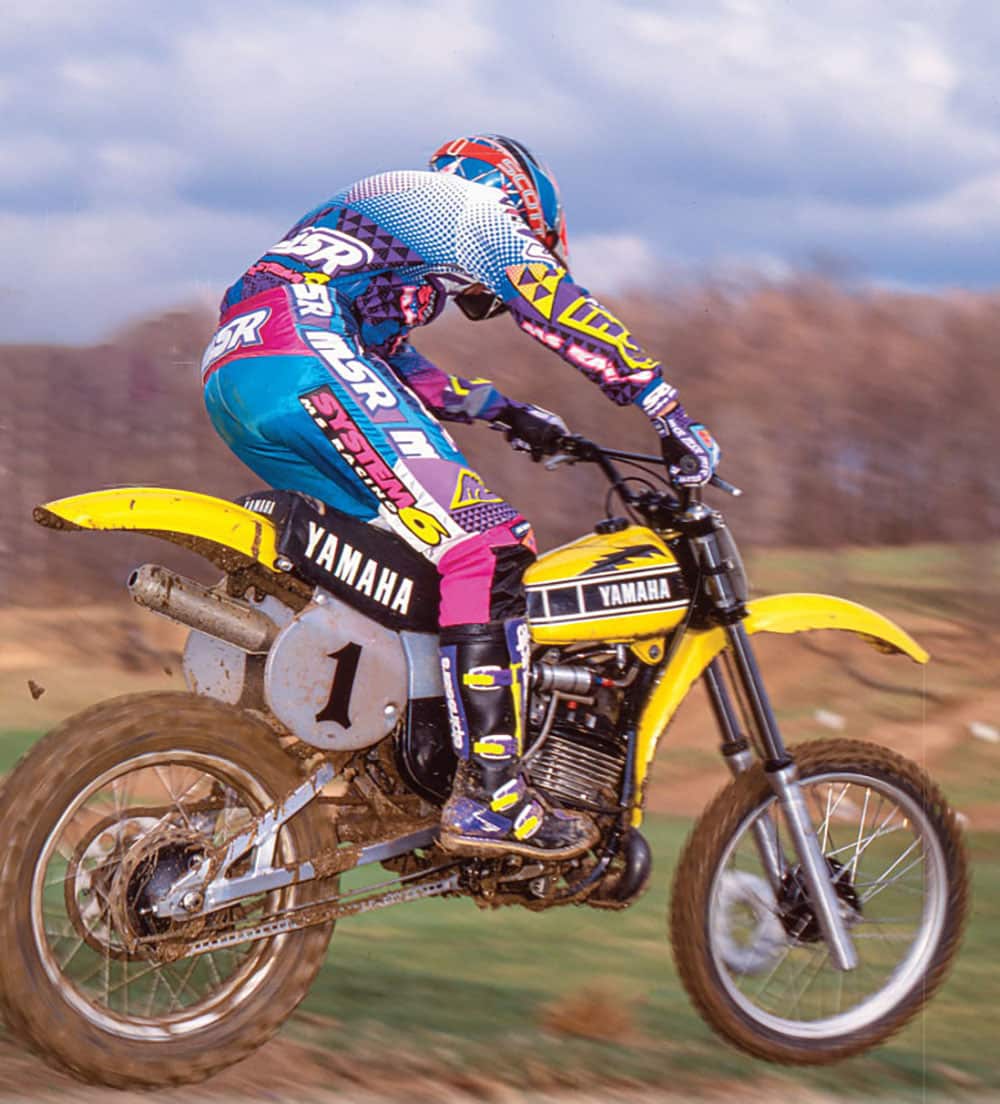
“The Yamaha’s power is very strong, too, but it’s not easy to use. The bike has a sharp midrange hit that is a little hard to control. When it’s on the powerband, though, the bike accelerates every bit as hard as a modern 250 MXer. In handling, on the other hand, the bike felt old. The front end felt like it had too much rake and the handlebar was too far rearward. I had to rotate the bar forward just to get my weight over the front end enough to make it turn. In this respect, the Suzuki and maybe even the Hondas of the time period were better.
“I had expected the fork to be stiff because Hannah was such a charger. It actually was very soft. I think this is because the rider is positioned so far to the rear. The fork had to be soft in order to get the bike to turn.
“Overall, I’m surprised in some ways about how good the bike is; in other ways, it is what I expected. I don’t think it would be competitive today, though. The bike obviously was designed for a very good rider. It takes a lot of expertise to keep the engine in the powerband and to get around tight corners. That’s probably why Bob developed a technique of skidding the rear wheel around the turns—he had to. He still turned like that years later when I worked with him at Honda.”
Was the bike magic? “No. The bike was, and still is, very good, but most of the magic came from Bob. He was at a point in his career when he could have won on anything. The fact that the bike also was excellent just made the two of them unbeatable.”

1981 SUZUKI RM125

While I was digging through the archives I ran across a photo of an iconic Suzuki–this time a production bike–of the same era. You can divide the history of the 125 two-stroke into two categories: before the 1981 Suzuki RM125 and after. It was a bike that changed everything and defined the class for the next 30 years.
In the ’70s, the 125 class and motocross in general were a primordial soup of evolution. The Honda CR125M got the ball rolling in 1973, and every year afterwards there was a new gold standard. In 1975 Yamaha offered the first single-shocker in the class, while Suzuki turned to a cantilevered twin-shocker. Kawasaki came up with the first vertically mounted rear shock in 1980, and there were a few misfires along the way, like Honda’s 23-inch front wheel in 1979. During all of this, the evolution of liquid-cooling was taking place behind closed doors in race shops. The first time it came into public awareness was in the 1976 National Motocross series when Bob Hannah debuted the exotic OW27. The feature was more or less offered to the public for the first time on the limited-production Mugen ME125 of 1980.
Everything came together on the 1981 liquid-cooled RM125 Suzuki Full Floater. Yamaha and Honda executives proudly unveiled their own liquid-cooled, single-shock 125s that year, but you could almost imagine how their hearts sank when they first saw the Suzuki. The RM125 made everything else look crude and primitive. The radiator was mounted low in the chassis rather than up high on the tank or triple clamp. The vertically mounted rear shock was compressed at a mildly rising rate and set the standard for suspension performance for years to come. That year in local motocross, the RM outperformed everything in the massively popular 125 class. In pro motocross, Mark Barnett was the 125 national champion on the works version of the bike.
Suzuki’s reign didn’t last long. Within a few years, all 125 motocross bikes looked like the RM. The coming of the power valve would elevate two-stroke performance to a higher level than ever. Rear suspension was simplified but still used the concept that was introduced on the RM. As advanced as the RM125 of 1981 was, the blistering pace of motocross technology soon left it behind. That bike’s main contribution was to point everyone in the right direction.
SPEAKING OF BOB …

- I also ran across this issue of Dirt Wheels with Bob Hannah on the cover riding an ATV in 1986. Classic…